
On-site detention OSD in NSW has been a standard condition of subdivision consent since the early 1990s. The idea is simple: detain stormwater on site, release it slowly, and avoid overloading Council’s drainage network downstream. In infill areas, where acquiring land for a regional alternative is rarely feasible, on-lot OSD is often the only practical option available.
The better solution in greenfield areas are regional detention basins: a single facility that manages stormwater for the entire catchment, maintained by Council or a Statutory Authority, with no fragmented ownership and no orifice plates disappearing because a homeowner did not know what they were.
This article explains why regional detention basins are the right answer for greenfield subdivisions, but what happens when the basin is not built yet, and what developers need to understand before the stormwater condition costs them.
How On-Site Detention OSD Works in NSW, and Where It Falls Short
The Mechanics and the Maintenance Problem
OSD has been applied as a condition of development consent under the Environmental Planning and Assessment Act 1979 since 1991, when the Upper Parramatta River Catchment Trust established the first coordinated policy across the region. The system works by temporarily storing stormwater on site and releasing it at a controlled rate through an orifice plate: a stainless steel plate with a precisely sized opening that throttles discharge into Council’s drainage network.
The problem is, what happens to that orifice plate ten years after the house is built? Homeowners see water filling up and the steel plate is the blockage, and it is removed. Contractors clearing out drainage systems pull it out without understanding what it does. The system blocks up or bypasses entirely. Nobody maintains it because nobody knows they are supposed to. And the Council, which holds a Positive Covenant on the title requiring the lot owner to maintain the system, has no practical mechanism to audit or enforce that obligation across thousands of individual lots.
Why the Positive Covenant Does Not Work in Practice
Under Section 88B or Section 88E of the Conveyancing Act 1919 (NSW), Councils register a Positive Covenant on the title of every lot with an OSD system. The Covenant requires the owner to maintain the system in working order. It runs with the land and binds every future owner.
The legal obligation is real, but it is impractical to try and enforce it. Councils cannot inspect every private OSD system across their local government area. There is no realistic audit programme. The system depends entirely on owner awareness that, in most cases, does not exist. When the orifice plate is removed and a storm event floods downstream, the Positive Covenant is cold comfort.
Why Regional Detention Basins Are the Better Answer
One Facility, One Point of Control
A Regional Detention Basin manages stormwater for the entire catchment from a single location. It is designed, built, and maintained by Council or a Statutory Authority. No Positive Covenant regime spread across hundreds of lots, and no orifice plates in the hands of homeowners.
The engineering case is well established. Individual on-lot OSD only captures runoff from the lot itself. Roads and other impervious shared areas bypass individual systems entirely. A Regional Basin captures the whole catchment, including roads, from a single design point. The system works as intended, and it stays that way because a competent Authority is responsible for it long term.
It Is Also the Right Land Use Decision
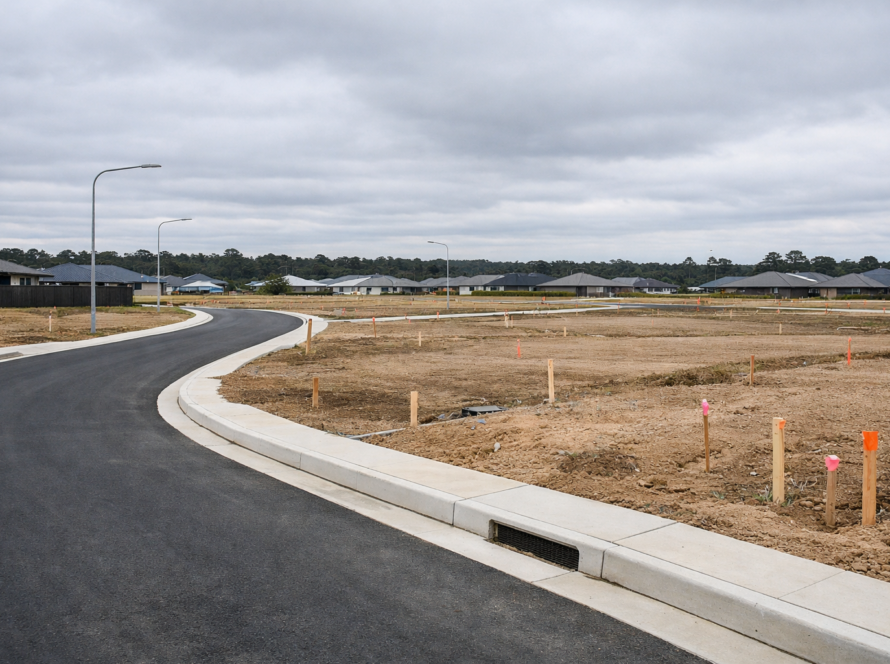
In a greenfield subdivision, land for a regional basin can be planned, reserved, and properly integrated into the estate layout from the beginning. There is no need to acquire land in an already-built environment, no need to retrofit infrastructure around existing development, and no need to impose stormwater restrictions on individual residential lots. The cost is built into the project economics through the developer contribution framework from day one.
How the Funding Framework Works in Greenfield NSW
Special Infrastructure Contributions and Section 7.11 Plans
This is where the greenfield context is genuinely different to infill. In NSW growth areas, regional stormwater infrastructure is funded through two primary mechanisms.
Special Infrastructure Contributions (SIC) are collected by the NSW Government in designated growth areas, including the Western Sydney Growth Areas and Western Sydney Aerotropolis precincts. Stormwater and drainage is an eligible infrastructure type under the SIC framework. The program has collected over $685 million to date, with funds allocated across major growth precincts to deliver state and regional infrastructure alongside development.
Section 7.11 contributions plans are used by Councils in greenfield areas to fund local infrastructure including regional detention basins. The nexus between the levy and the facility is established in the plan, and developer contributions accumulate as lots are created. The Accelerated Infrastructure Fund has also provided direct NSW Government grants to Councils to deliver stormwater infrastructure ahead of development, specifically to unlock housing in greenfield release areas.
The Western Sydney Aerotropolis is the clearest example of this approach in practice. The NSW Government appointed Sydney Water as the Regional Stormwater Authority for the five initial Aerotropolis precincts. Sydney Water’s stated objective for its centralised stormwater scheme is to minimise on-site stormwater requirements and maximise developable land. That is precisely the benefit of the regional approach, now embedded in government policy for NSW’s largest growth corridor.
When the Funding Is There but the Basin Is Not
Here is where theory meets project reality. The SIC is being collected. The s7.11 contributions plan identifies the regional basin. The funding is accumulating. But the basin will not be delivered for another four, five, or seven years.
In that window, the developer still has a stormwater problem to solve. The current solution to that problem is the temporary OSD basin requirement.
The Greenfield Problem: When the Regional Basin Is Not Built Yet
The Temporary OSD Basin Requirement
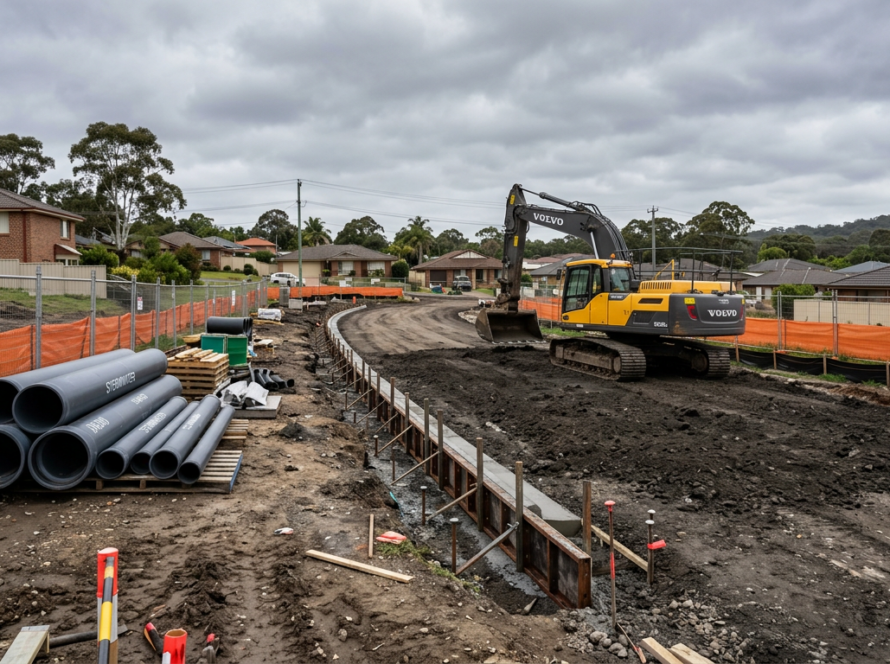
Where the planned downstream regional basin has not yet been constructed, the development consent will typically require the developer to construct a temporary OSD basin on the subdivision site. This basin serves the catchment until the regional facility becomes operational, at which point it is decommissioned. The Subdivision Works Certificate for the project will capture this as a civil works obligation.
The basin occupies land. It may occupy a lot that was planned for sale. And every surrounding lot that drains to it gets tagged with title restrictions registered at NSW Land Registry Services.
The Three Restrictions That Attach to Every Affected Lot
This is the part most developers underestimate until they are already committed to a project.
First, a Positive Covenant requiring maintenance. The lot owner is bound by Positive Covenant to maintain the temporary basin until Council formally confirms the regional facility is operational. This obligation runs with the land and binds any purchaser.
Second, a Restriction on use preventing construction. A Restriction on the use of land under Section 88B prevents construction of a dwelling on the affected lot until the lot has been filled to an appropriate finished level and Council has formally confirmed suitability for building. The Restriction is registered on title and is visible to any purchaser’s conveyancer or investor.
Third, a formal Council release before building can proceed. The Restriction does not lift automatically when the regional basin is built. Council must actively remove it, which requires a separate application, Council assessment, and registration at NSW LRS. That takes time.
The Commercial Reality for Developers
Lots With Restrictions Are Harder to Sell and Slower to Settle
A lot with a Restriction on title is not the same product as a clean lot. Purchasers’ solicitors will raise it. Lenders may require clarification. Purchasers who do not understand what the Restriction means will be cautious or negotiate a price discount. Developers who have not factored this into their sales and settlement strategy often find these lots sitting at the back of their release schedule while they wait for the removal process.
Yield Risk and Feasibility Blind Spots
If the temporary basin occupies a lot that was planned for sale, the developer has lost yield. That lot is not generating revenue; it is generating holding costs. The difference between a temporary basin sited on dedicated drainage reserve and one sited on a prospective residential lot is the difference between a manageable condition and a material feasibility hit.
Working across major greenfield residential projects across NSW, including 154-lot to 300-lot residential subdivisions, the projects where stormwater conditions cause the most disruption are consistently those where the temporary OSD requirement was not properly interrogated at feasibility stage. The condition is in the DA consent, but without understanding the impact of what the words mean, it is usually too late once construction has started.
Frequently Asked Questions
What is a Positive Covenant on an OSD system in NSW?
A Positive Covenant is a legal obligation registered on the title of a lot that requires the landowner to take a specific action, in this case, to maintain an on-site stormwater detention system in working order. It is created under Section 88B or Section 88E of the Conveyancing Act 1919 (NSW) and runs with the land, binding every future owner. Council is nominated as the Authority empowered to release, vary or modify the Covenant.
When is a temporary OSD basin required in a greenfield subdivision?
A temporary OSD basin is typically required when the development consent includes a stormwater management condition and the planned downstream regional detention basin has not yet been constructed. Council requires the developer to manage stormwater on site in the interim, with the temporary basin remaining in service until the regional facility is operational and Council formally confirms its decommissioning.
Can a restriction on title be removed before the regional basin is built?
Generally, no. The restriction is in place because the permanent stormwater solution is not yet available. Council must formally confirm that the regional facility is operational before it will consider removing the restriction.
How does a regional detention basin remove the need for on-lot OSD in NSW?
Where Council or a Statutory Authority has provided regional detention capacity at catchment level, lots within that catchment are typically exempt from on-lot OSD requirements. The regional facility handles peak flow attenuation for the whole catchment, removing the need for individual systems on each lot. This is the model being implemented across the North West and South West Growth Centres.
Conclusion
Regional detention basins are the right solution for greenfield subdivisions. The engineering case is clear, the funding framework exists through SIC and s7.11 contributions, and the NSW Government is actively moving in this direction in its major growth precincts. On-lot OSD, by contrast, is a fragmented approach that degrades over time, relies on enforcement that does not work in practice, and in the greenfield context, creates title restrictions with real commercial consequences.
The risk for developers is not the regional basin itself. It is the timing gap between when development consent is issued and when the basin is actually delivered. That gap is where temporary OSD requirements, title restrictions, and holding costs accumulate. Identify the stormwater condition early, understand the contributions plan and basin delivery timeline, and get the restriction removal process agreed with Council before titles are registered.
If you are planning a greenfield subdivision in NSW and want clear advice on the certification pathway and stormwater conditions, Southwell Certifiers can help. To discuss your project and receive a no-obligation fee proposal, contact us on (02) 8734 5676, email admin@southwellcert.com.au, or request a fee proposal.