
You plan on subdividing your site, the road out front is split down the middle. One half is new: clean kerb and gutter, fresh stormwater drainage, sealed pavement. Your half is cracked asphalt, patched potholes, no kerb, no drainage. That gap is your problem to fix.
This is a common scenario in NSW land subdivision, and the obligations it creates catch a lot of developers off guard. It is not just about construction costs. Before you break ground, Council will require a performance bond that could be worth 100% to 200% of the entire cost of the road and drainage works. That is cash or a bank guarantee tied up for the duration of construction, on top of everything else you are managing.
Understanding what half road construction requires, how Section 138 of the Roads Act 1993 operates, and what the associated bonds actually cost is essential before you commit to a programme or finalise your feasibility.
What Is Half Road Construction and When Does It Apply?
The Scenario Explained
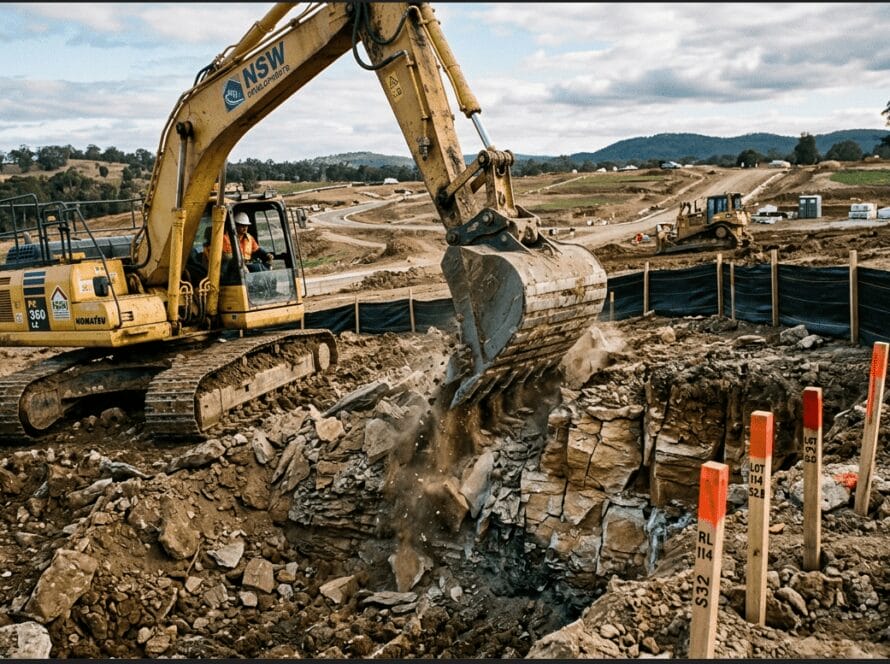
When a DA subdivision site fronts a public road that has only been partially constructed, the developer is typically required to build the missing infrastructure along their frontage as a condition of development consent. This is referred to as half road construction, because the developer constructs their carriageway width while the other side of the road already exists.
The situation arises in infill and greenfield subdivisions where surrounding development has been staged over time. One side of the road gets built when the earlier subdivision was developed. Your side remains incomplete until your project triggers the obligation.
What Works Are Typically Required
The scope of works generally includes the following:
- Kerb and gutter construction for the full frontage of the development
- Installation of stormwater infrastructure under the kerb
- Connection to the existing council stormwater system
- Road pavement construction and line marking
- Footpath and nature strip works in some cases
How Far the Works May Extend Beyond Your Frontage
The works are not always confined to your exact frontage. Council may require the new kerb and gutter and stormwater infrastructure to extend beyond your lot boundary to connect to the nearest existing pit or pipe. The extent depends on the engineering design and council’s specific requirements.
Section 138 of the Roads Act 1993: What It Is and Why It Matters
What Section 138 Authorises
Any works within a public road reserve require formal consent from the roads authority under Section 138 of the Roads Act 1993. This covers construction or alteration of kerb and gutter, stormwater drainage connections, road pavement works, footpaths, and any other structure or activity within the road reserve.
For most residential and infill subdivisions, the roads authority is the local council. Works on classified roads may require separate authorisation from Transport for NSW.
How Section 138 Fits Into Your DA Pathway
For DA approved projects, Section 138 approval is obtained after the DA is granted and before civil works commence on the road reserve. It is referenced directly in your consent conditions. The NSW Planning Portal outlines how Section 138 integrates with this pathway.
In practice, the Section 138 approval forms part of the overall Subdivision Works Certificate package and must be in place before any works begin within the road reserve.
Your consent will typically contain a specific condition requiring Section 138 approval prior to commencement of road and drainage works. Missing or delaying this step can hold up your entire construction programme.
Classified vs Unclassified Roads
For Unclassified roads, which covers the majority of local residential streets, Council is the Consent Authority. For Classified roads managed by Transport for NSW, additional approvals including a Works Authorisation Deed may be required. Confirm road classification early, as this affects both approval timing and the extent of documentation required.
Performance Bonds for Half Road Construction NSW
What Is a Performance Bond in Subdivision?
A performance bond is a financial security lodged with Council before civil works begin on public infrastructure. It is held by Council for the duration of construction up until the Subdivision Certificate and the assets are dedicated. It serves one purpose: if the developer stops work, defaults, or becomes insolvent mid-project, Council has the funds to step in and complete the road and drainage works rather than leave a half-finished road open to the public.
The bond is not a fee. It is a refundable security. In most cases once the Subdivision Certificate is signed by Council, the performance bond is released.
How Much Is the Bond?
Bond requirements vary by Council. Based on standard practice across NSW, performance bonds for road and drainage works typically range from 100% to 200% of the estimated cost of works. Many Councils set the requirement at 150% of the value of outstanding works.
On a mid-size infill subdivision where half road construction and drainage works total $300,000, a 150% bond means $450,000 lodged with council before works start. At 200%, that rises to $600,000.
This is a material cash flow item. If you are using a bank guarantee, your financier needs to be across it. If you are using cash, it needs to be in your project budget from day one.
The Security for Contributions and Planning Agreements guidance on the NSW Planning Portal outlines the general framework. Individual Councils set their own percentages and may adjust the bond amount at different stages of the works.
When and How the Bond Is Released
Once the road and drainage works are completed and inspected to Council’s satisfaction, the performance bond is released, but in some circumstances once the Subdivision Certificate has been signed by Council. For staged releases, some Councils will partially release the bond as sections of work are completed, with the balance held until final sign-off.
The release process typically involves a formal inspection request, a works-as-executed survey, and material and compaction reports. Without it, the bond does not move.
Maintenance Bonds After Handover
What the Maintenance Bond Covers
Once the road and drainage works are completed and handed over to Council, the obligation does not end immediately. Council accepts the new infrastructure as a public asset, but it requires a separate security to cover defects that may emerge within the first 12 months of service.
This is the maintenance bond, sometimes called a defects liability bond. If a new stormwater pipe fails, a kerb section settles, or the road pavement shows early distress, Council can use this bond to fund rectification works if the developer does not respond in time.
Typical Requirements
Most NSW Councils set the maintenance bond at 5% to 10 % of the total value of the new infrastructure. The 12-month defects liability period runs from the date Council accepts the works. At the end of that period, provided no defects have been identified or any identified defects have been rectified, the bond is refunded in full.
At 5% on $300,000 worth of road and drainage works, the maintenance bond is $15,000.
What This Means for Your Feasibility and Cash Flow
Why This Cost Gets Missed
The performance bond is easy to overlook in a development consent. Consent conditions can run to dozens of pages. Bond conditions are often buried in the engineering or infrastructure section, written in technical language, and not flagged by anyone unless someone is specifically reviewing for financial exposures.
The construction cost of the half road itself often gets captured in feasibility. The bond does not. It is not a construction cost; it is a cash bond or bank guarantee that sits with Council for months sometimes years. On larger projects with significant road frontage, that amount can exceed $500,000 to $1,000,000. The impact on equity return and finance costs is real.
The Most Common Mistake
The most common mistake is not identifying the bond condition until after finance has been drawn down. At that point, finding an additional six-figure security at short notice puts pressure on the entire project.
How to Identify It Early
The best time to identify half road construction obligations is before you sign a contract on the site. Have your Civil Engineer review the road frontage condition against council’s adopted subdivision design standards. If the existing road is not constructed to council’s current standard, assume an obligation exists.
Once DA consent is issued, read every condition. A reference to Section 138 approval or road and drainage works is a trigger to cost the bond exposure immediately, not at construction commencement.
Frequently Asked Questions
Does Every NSW Council Require the Same Bond Amount?
No. Bond requirements are set by individual councils and can vary significantly. The range across NSW is broadly 100% to 200% of the cost of works for performance bonds and 5% for maintenance bonds but confirm the exact requirement with the consent authority for your specific project. Most councils publish their bond policy in their fees and charges schedule or engineering guidelines.
When Do I Need to Lodge the Section 138 Approval?
For DA projects, Section 138 approval is obtained after the DA is granted but before civil works commence on the road reserve. Check the specific consent condition in your approval, it is usually required prior to Subdivision Works Certificate, you can confirm the timing with your Registered Subdivision Certifier.
What Happens If I Overlook a Bond Condition in My Consent?
Usually, Council will not issue your Section 138 Roads Act Approval, it if it missed, you are in breach of your consent conditions. It is likely Council can issue a stop work order, and the bond must be lodged before works can recommence. Beyond the delay, it creates exposure on your finance facility and construction programme. Reading and actioning every consent condition before construction begins is not optional.
Can I Use a Bank Guarantee Instead of Cash for the Bond?
Yes. Most NSW Councils accept both cash and an unconditional bank guarantee issued by an Australian authorised deposit-taking institution. Bank guarantees must typically be unconditional and have no expiry date. Using a bank guarantee rather than cash preserves your working capital but requires your financier to be engaged early. Confirm the acceptable security format with the specific council, as some have particular requirements around the form of guarantee.
The Takeaway
Half road construction obligations are a normal part of infill and greenfield land subdivision in NSW. The works themselves are straightforward. What catches developers out is the cost of the performance and maintenance bonds attached to those works, and how late in the process those bonds are typically identified.
Know the road condition before you buy. Read your consent before you build. Cost the bonds when you cost the construction. These are not edge cases; they are standard conditions on standard projects across NSW.
If you are planning a land subdivision in NSW and want clear advice on the certification pathway, Southwell Certifiers can help. To discuss your project and receive a no-obligation fee proposal, contact us on (02) 8734 5676, email admin@southwellcert.com.au, or request a fee proposal.