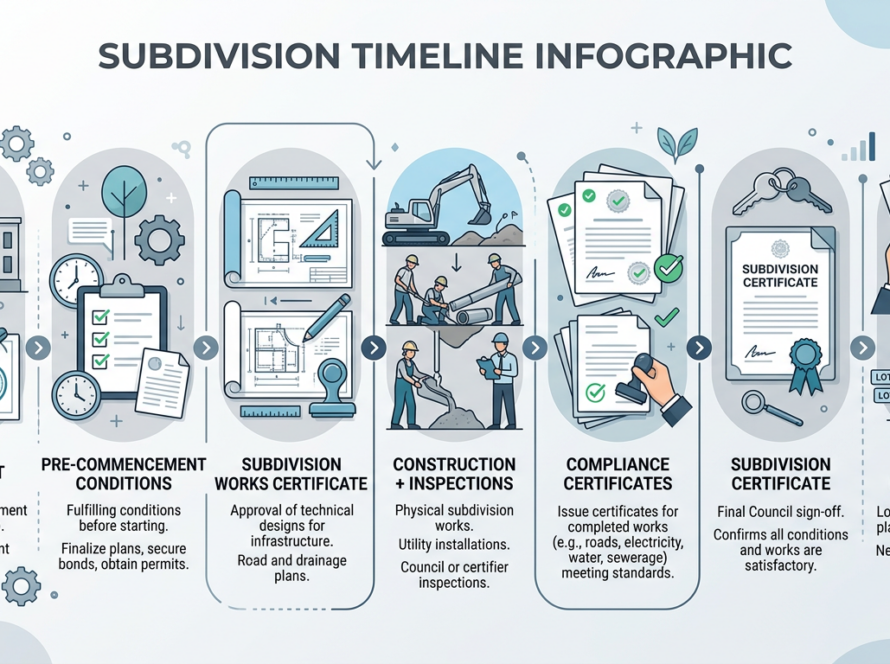

A Subdivision Works Certificate in NSW certifies the internal private works for a subdivision. The submission package falls into three groups: P1 (Plans), B + CW (Approvals from other authorities) and M (Miscellaneous plans and approvals). This is the subdivision works certificate checklist NSW developers need to lodge a complete package.
The SWC sits between your DA consent and the start of civil works. Get the package wrong and the certificate is held up, the bank gets nervous, and the contractor can’t start. Get it right and you start on time.
This guide breaks down each group, what sits inside it, and the items that most commonly hold up a lodgement.
What a Subdivision Works Certificate Actually Certifies
A Subdivision Works Certificate is issued under section 6.15 of the Environmental Planning and Assessment Act 1979. It confirms that the proposed subdivision works, as designed, will comply with the conditions of development consent and the relevant regulations and standards.
Two points are often missed by developers and project teams.
First, the SWC certifies the internal private works only. Roads, drainage, sewer and water inside the development site, plus any private infrastructure that will remain in private ownership. Anything in the public road reserve, or connecting to a public main, is a separate approval issued by the relevant authority. Those external approvals must be in place, but they sit alongside the SWC, not inside it.
Second, the SWC is a DA-only certificate. It is not used on a CDC subdivision. If your project is being delivered through a Complying Development Certificate, the civil works are approved under the building CDC. See our explainer on SWC vs Subdivision Certificate for the broader sequencing.
A Registered Certifier can issue the SWC under section 6.5 of the EP&A Act, provided the consent does not specifically require council to issue it. Engaging the certifier early is the single biggest factor in a clean lodgement.
P1 — The Plans Set (Internal Private Works)
P1 is the design and documentation package. Everything in this group describes what is being built on the site, and it is signed off by the responsible designers.
Core P1 documents
- DA consent notice and conditions of consent. The certifier works from the consent, not a generic checklist. Every condition is read against the package.
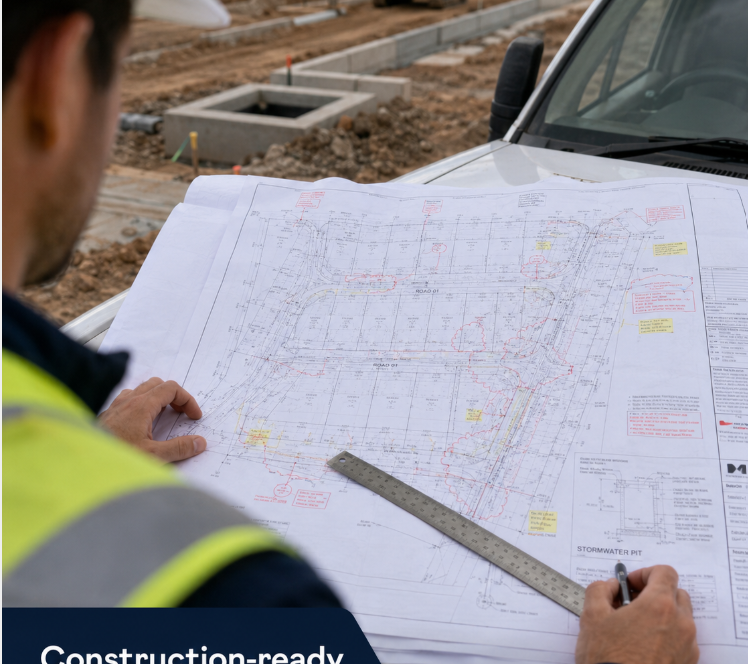
- Construction-level civil engineering drawings for the internal works: internal roads (where private), private stormwater, sewer and water reticulation, earthworks, retaining structures and utility layouts.
- Stormwater Management Plan (SWMP). Quantity and quality controls, OSD where required, discharge points and design storms.
- Erosion and Sediment Control Plan (ESCP) prepared under Managing Urban Stormwater: Soils and Construction (the Blue Book).
- Designer’s compliance certificates for each civil discipline, stamped by a CPEng or RPEQ.
- Structural engineer plans and certificates for any work requiring structural design. This typically covers retaining walls, concrete works including underground OSD tanks, driveway slabs and large custom pits. Scope depends on the council’s engineering standards and the specific conditions of consent.
- Geotechnical report and the survey set the design is based on.
- Long Service Levy receipt for works valued above the threshold (currently $250,000).
The drawings must be construction-ready. A design issued for DA assessment is rarely construction-ready, and submitting that version is one of the fastest ways to get an SWC sent back for amendment. The civil engineer should issue a final construction set with all comments resolved before lodgement.
B + CW — Approvals From Other Authorities
This group covers the external approvals that need to be in place because the internal works connect to, or interact with, public assets and utility networks.
- Section 138 Roads Act approval for any work in the public road reserve. This covers driveway crossovers, kerb and gutter, footpath works and road openings. The roads authority, usually council, holds a security bond as part of this approval.
- Sydney Water Notice of Requirements (NOR). This is the document needed at SWC stage. The full Section 73 Compliance Certificate under the Sydney Water Act 1994 is not required prior to SWC. The NOR sets out what water, wastewater and stormwater works the developer needs to deliver, and obtaining it is almost as cumbersome as obtaining the Compliance Certificate itself. Start the application early.
- Ausgrid Notification of Arrangement for electricity supply and street lighting.
- NBN Co Certificate of Practical Completion of Developer Activities for pit and pipe.
- Jemena or Agility sign-off where gas reticulation is required.
Each authority runs to its own timeline. Section 73 and NBN can sit at six to twelve weeks each, sometimes longer if the application is incomplete or the lot is remote. The fix is to lodge all four referrals in parallel on day one of the consent, not sequentially as the design firms up.
Where the project includes a Compliance Certificate from a designer or specialist, that document is normally bundled into the relevant approval pathway and noted in the SWC package.
M — Miscellaneous Plans and Approvals
M is the group that gets missed most often. These documents are not always called out clearly in the consent conditions, but they are required, and lodging without them is a common cause of delay.
- Landscape Plans for street trees, verges and common open space.
- Public Lighting Design Brief coordinated with Ausgrid.
- Local Traffic Committee approval for new signs and linemarking on public roads.
- Vegetation Management Plan where retained vegetation is part of the consent.
- Construction Environmental Management Plan (CEMP) covering sediment, noise, dust, traffic and waste during the works.
- Arborist engagement and arborist report with tree protection zones, retention and removal sign-off.
The Local Traffic Committee approval is the trap. It is a separate process administered through council and the regional traffic group, and it can take six to eight weeks. If signs and linemarking are anywhere in the design, this needs to be started early.
Five Things That Hold Up an SWC (and How to Avoid Them)
Across more than 35 NSW councils and dozens of SWC projects, the same items hold up lodgements.
- Missing Section 138 approval and the associated bond. Any disturbance in the road reserve triggers this, including the crossover.
- Service authority referrals lodged too late. The Sydney Water NOR, NBN, Ausgrid and gas all run in parallel from day one of the consent.
- Long Service Levy missed. It applies to subdivision works above $250,000, not just building works.
- Engineering plans not construction-ready. DA-stage drawings are not enough.
- M-category items overlooked. Local Traffic Committee approval and arborist sign-off are the usual offenders.
A more detailed breakdown sits in our article on the 5 SWC conditions developers miss most often.
How to Run the SWC Package So It Gets Issued First Time
Four things consistently get the SWC issued on the first lodgement.
Engage your certifier before the civil engineer finalises the design. A pre-design conversation about the conditions of consent surfaces issues while they are still cheap to fix.
Lodge all external authority referrals in parallel from day one of the consent. Sydney Water (Notice of Requirements), NBN, Ausgrid, gas and the roads authority should all be moving at the same time as the engineering design.
Build the package against the actual conditions of consent. A generic checklist is a starting point. The certifier reads against your consent and your project.
Run a pre-lodgement review with your certifier. A short review against the conditions of consent and the three-group structure above catches the items most likely to bounce.
FAQ
Q: What is the difference between a Subdivision Works Certificate and a Subdivision Certificate in NSW?
A: An SWC is issued before the civil works start and certifies that the design complies with the consent. The Subdivision Certificate is issued at the end and authorises the plan of subdivision to be registered with NSW Land Registry Services. They are two separate certificates at two separate stages of the project.
Q: Can a private certifier issue a Subdivision Works Certificate?
A: Yes. A Registered Certifier can issue the SWC under section 6.5 of the EP&A Act, provided the consent does not specifically require council to issue it. A private certifier typically gives developers a faster and more predictable turnaround than the council pathway.
Q: How long does it take to get a Subdivision Works Certificate in NSW?
A: Once the full package is lodged with all external authority approvals in hand, a Registered Certifier can typically issue the SWC inside one to two weeks. The bottleneck is almost always the external referrals, not the certifier’s assessment.
Q: Do you need a Subdivision Works Certificate for a CDC subdivision?
A: No. The SWC is a DA-only certificate. Where the subdivision is approved under a Complying Development Certificate, the civil works are approved under the building CDC pathway, not a separate SWC.
Q: What does it cost to get a Subdivision Works Certificate in NSW?
A: The certifier’s fee depends on the size of the project, the number of lots and the complexity of the civil works. The fee for a 2-lot infill project sits well below the fee for a 40-lot or 134-lot staged release. Request a fee proposal for a fixed quote on your project.
Conclusion
The full SWC submission package fits cleanly into three groups: P1 for the plans, B + CW for the external authority approvals, and M for the ancillary plans. If each group is closed out before lodgement, the certifier issues the SWC and the project starts on time.
The two most common failure points are external authority referrals lodged too late, and M-category items missed entirely. Both are avoidable with early engagement.
If you are planning a subdivision in NSW and want clear advice on the SWC pathway, Southwell Certifiers can help. To discuss your project and receive a no-obligation fee proposal, contact us on (02) 8734 5676, email admin@southwellcert.com.au, or request a fee proposal.