
Five conditions stop a Subdivision Works Certificate from being issued more often than any others in NSW: Section 138 Roads Act approval, service authority approvals, the Long Service Levy payment, dilapidation reports and security bonds, and engineering plan amendments to a construction-ready set.
Each one sits between the DA consent and the SWC. Each one stops the project until it is cleared. The pattern across most lodgements is the same. The developer assumes the consent is the green light, the contractor turns up, and the certifier flags a list of items that should have been worked through weeks earlier.
This article walks through the five that come up again and again. The aim is simple. Know what is sitting on the SWC checklist before you lodge, and you can run them in parallel instead of one at a time.
Why these SWC conditions catch developers out
A development consent is permission to develop, not permission to start work. A Subdivision Works Certificate is the legal trigger to begin civil works under that consent. The certifier cannot issue the SWC until every condition the consent says must be cleared “prior to issue of the Subdivision Works Certificate” has been satisfied and evidenced.
That is the gap. Most consents carry 40 to 80 conditions. A subset sit on the SWC. Another subset sit on the Subdivision Certificate at the end of the job. Between the two sit the compliance certificates for subdivision works, which verify the civil works as built. Sorting them is straightforward once you know what to look for. Missing them costs weeks.
With more than 15 years issuing Subdivision Works Certificates on projects ranging from 2-lot infill to over 200-lot subdivisions across NSW, the same five conditions account for most delays at lodgement. They are listed below in the order they typically catch developers out.
Condition 1: Section 138 Roads Act approval
A Section 138 Roads Act approval is required for any work or activity in a public road reserve. That covers driveway crossings, kerb and gutter works, road openings, footpath works, and anything that involves machinery operating on the public road.
The trap is that an s138 approval is separate from the DA, separate from the SWC, and separate from the certifier’s assessment. It is issued by the roads authority, usually the local council, sometimes Transport for NSW where the works touch a classified road.
Most subdivision projects involve at least some work in the road reserve. New driveway crossovers, road widening, kerb adjustments, stormwater connections through the kerb, footpath reinstatement after services trenches. If your consent conditions name s138, that approval needs to be in hand before the SWC can issue.
Two things developers miss most often:
- The s138 application is a separate lodgement to council, with its own fee, its own assessment timeframe, and its own conditions.
- For works on a classified road, additional approval is required from Transport for NSW, which can add a Works Authorisation Deed and Road Occupancy Licence on top.
Lodge the s138 in parallel with the SWC application, not after. Council assessment teams are often the same people, but the workflows are not.
Condition 2: Service authority approvals
This is the largest single bucket of SWC delays. Conditions of consent typically require approval or evidence of arrangements from four service authorities before the SWC can issue: water, electricity, gas, and telecommunications.
Water (Sydney Water, Hunter Water, or local water authority). A Notice of Requirements is the standard requirement in the Sydney Water area. Sydney Water assesses the application, issues a Notice of Requirements detailing any works needed, and only issues the certificate after those works are constructed and inspected. The Notice of Requirements alone typically takes around six weeks. Major works can run substantially longer.
Electricity (Ausgrid, Endeavour Energy, or Essential Energy). Ausgrid and the other two NSW distributors issue a Notification of Arrangement confirming the developer has paid connection fees and made arrangements for the electrical reticulation, including any required street lighting. Where network augmentation is needed, design and construction by an Accredited Service Provider sit on the critical path.
Telecommunications (NBN Co or alternative carrier). NBN Co issues a Certificate of Practical Completion of Developer Activities once the pit and pipe infrastructure is constructed and inspected. The NSW Planning Circular PS 21-025 sets out the standard fibre-ready facilities condition that most consents now incorporate.
Gas. Where the consent requires gas reticulation, evidence of arrangements with the gas distributor is needed before the SWC.
The mistake is treating these as a sequence. They are not. Each one runs on its own timeline, often six to twelve weeks, sometimes longer. They have to run in parallel from day one of the consent.
Condition 3: Long Service Levy payment
The Long Service Levy is the simplest condition on the SWC list, and the one that most often gets missed on subdivision-only jobs because developers associate the levy with building work.
The levy applies to all subdivision works valued at $250,000 or more. The current rate is 0.25% of the cost of works including GST, payable to the Long Service Corporation before the SWC can be issued.
The legal basis sits in Section 6.14 of the Environmental Planning and Assessment Act 1979. The certifier is prohibited from issuing the SWC until the levy receipt is in the file. There is no discretion. No payment, no certificate.
For a $2 million subdivision civil works package, the levy is $5,000. For a $500,000 package, it is $1,250. The amount is small relative to the project. The delay if it is forgotten is not.
Condition 4: Pre-construction dilapidation report and security bonds
Most NSW councils impose two related conditions on the SWC:
- A pre-construction dilapidation report on adjoining buildings, council infrastructure, and any structures within a defined zone of influence, prepared by a suitably qualified engineer.
- A security bond or bank guarantee lodged with council to cover the cost of any damage to public assets and any outstanding works.
Most NSW councils impose two related conditions on the SWC:
- A pre-construction dilapidation report on adjoining buildings, council infrastructure, and any structures within a defined zone of influence, prepared by a suitably qualified engineer.
- A security bond or bank guarantee lodged with council to cover the cost of any damage to public assets and any outstanding works.
Condition 5: Engineering plan amendments and construction-ready drawings
This is the condition that catches the most experienced developers. It also costs the most time when it is missed.
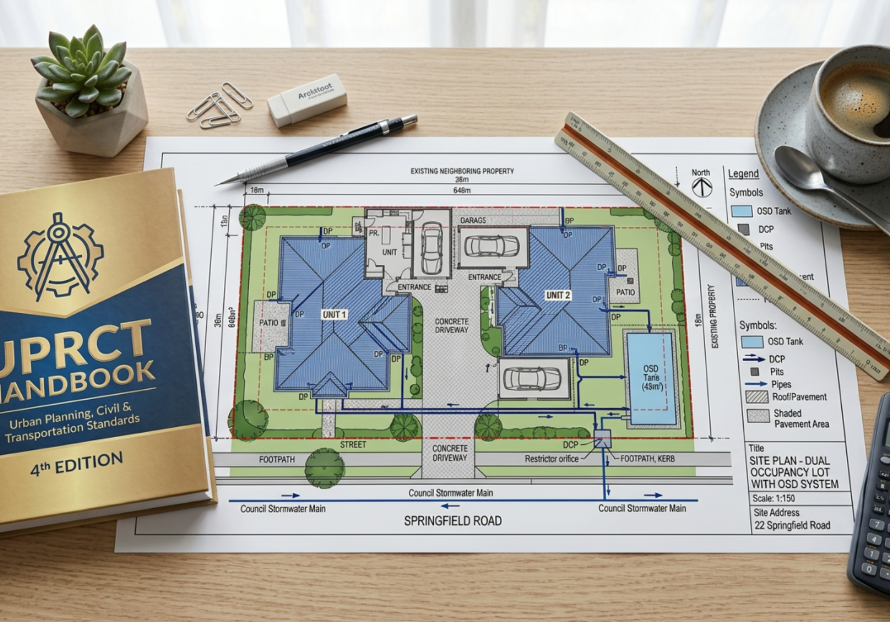
The plans stamped with the DA consent are almost never marked “for construction.” They are concept plans, sufficient for council to assess and approve the development, but not detailed enough to build from. The SWC application requires a construction-ready set.
Two separate things drive the amendments.
Council conditions. The consent will typically include conditions worded along the lines of “the engineering plans must detail…” or “the following amendments are required prior to the issue of the Subdivision Works Certificate.” Council is approving the development concept, then telling you what needs to be added or changed before construction can start. Cross-falls, pavement detail, levels at lot corners, drainage layouts, sediment controls, traffic management, batter treatments, and retaining wall design are common items added by condition.
Other authority approvals. Where the development was assessed as integrated development, General Terms of Approval (GTAs) from other authorities are incorporated into the consent. Common examples include:
- NSW Rural Fire Service GTAs for bushfire-prone subdivisions, which can require asset protection zones, water supply arrangements, access standards, and construction setbacks to be detailed on the plans.
- Transport for NSW conditions on classified road frontages, requiring traffic and access detail to be added.
- WaterNSW or EPA conditions on environmentally sensitive sites.
Each set of GTAs will often require the engineering plans to be modified to show how the conditions are addressed. The SWC needs the amended set, not the DA set.
The practical impact:
- The civil engineer needs to take the DA-stamped plans, work through every condition and every GTA, and produce a fully detailed construction set. That is a real piece of work, often four to six weeks for a typical small subdivision.
- If the engineer is not engaged early, this becomes the longest item on the SWC critical path.
- If the construction plans are submitted to the certifier in their DA form, the SWC cannot be issued. The plans go back for amendment, and the project stops.
How to avoid Subdivision Works Certificate delays
None of these five conditions are unusual. They are written into nearly every NSW subdivision consent. The delay comes from treating them as a sequence after consent, instead of parallel workstreams from the day the DA is approved.
A practical sequence:
- The day consent is granted, build a condition matrix. List every condition, group them by SWC, Subdivision Certificate, and Occupation Certificate. Assign each one to a responsible party with a target date.
- Lodge the s138 application, the Section 73, the Ausgrid Notification of Arrangement, and the NBN application within the first two weeks. They run in parallel.
- Engage the civil engineer to produce the construction set immediately. Hand them the consent and every GTA.
- Brief the dilapidation engineer and the bond provider before the construction set is finalised.
- Pay the Long Service Levy as soon as the construction cost is settled.
- Lodge the SWC application with the construction-ready plans, the levy receipt, the dilapidation report, the bond evidence, and a Compliance Certificate report mapping every condition to a document.
The certifier’s job is to verify, not to chase. A complete application moves through fast. An incomplete application stops at the first item missing from the file.
If you are planning a subdivision in NSW and want clear advice on the certification pathway, Southwell Certifiers can help. To discuss your project and receive a no-obligation fee proposal, contact us on (02) 8734 5676, email admin@southwellcert.com.au, or request a fee proposal.
FAQ
What conditions must be met before a Subdivision Works Certificate is issued in NSW?
Every condition of consent marked “prior to issue of the Subdivision Works Certificate” must be cleared. The most commonly missed are Section 138 Roads Act approval, service authority approvals (water, electricity, gas, telco), the Long Service Levy payment, dilapidation reports and security bonds, and amendments to bring DA-stamped plans up to a construction-ready standard.
Are DA-stamped plans the same as construction plans for an SWC?
No. DA plans are concept plans approved for the purpose of granting consent. They are rarely detailed enough to build from. The SWC application requires a construction-ready set, amended to address every condition of consent and every General Term of Approval from other authorities. Most consents specifically require these amendments before the SWC can be issued.
Do you need to pay the Long Service Levy on subdivision works?
Yes, where the cost of subdivision works is $250,000 or more (including GST). The current rate is 0.25%. The levy must be paid before the Subdivision Works Certificate can be issued, under Section 6.14 of the Environmental Planning and Assessment Act 1979. The certifier has no discretion to waive or defer it.