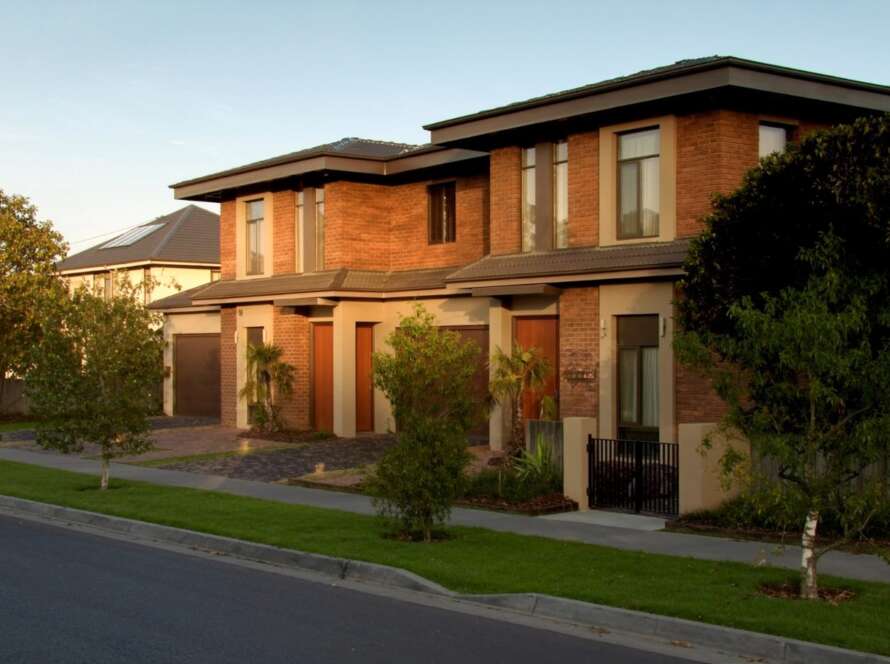

Yes. A duplex with one shared driveway can still be Torrens title subdivided in NSW. The Codes SEPP requires each lot to have frontage to a public road, not its own driveway. A shared driveway with reciprocal rights of carriageway satisfies the access requirement.
This question comes up constantly on constrained sites. A street tree or power pole sits exactly where the second driveway would go, so the designer proposes a single crossover serving both dwellings. Owners then worry the shared driveway has locked them out of Torrens title. In most cases, it has not. The State Environmental Planning Policy (Exempt and Complying Development Codes) 2008 anticipates this exact scenario and provides a clean mechanism to deal with it.
Why Some Duplex Designs End Up With a Single Driveway
The standard side by side duplex has two driveways, one per dwelling. On many sites that simply does not work.
Street trees and power poles
A power pole on the frontage is the most common culprit. Ausgrid’s Network Standard NS167 requires a minimum 1.5 metre clearance from the face of a pole to any part of a driveway, including the layback. On a 15 to 18 metre frontage already accommodating two garages, that clearance can make a second crossover physically impossible.
Established street trees create the same problem. Councils protect them, and removal is rarely approved just to fit a second driveway. Relocating a pole is possible, but the cost and lead time often kill the idea.
Narrow frontages and on-street parking
Design criteria 18 under section 2.1F of the Low Rise Housing Diversity Design Guide says that any vehicular crossing should have a maximum width of 3.5m at the street boundary, and design criteria 17 expects at least one on-street parking space to be retained where one currently exists. Two separate crossovers eat up frontage quickly. On narrower blocks, a single central driveway that splits behind the boundary is the only layout that satisfies the parking and access criteria together.
So a shared driveway is often not a design preference. It is the only answer the site allows. The question is whether it survives subdivision.
What the Codes SEPP Requires for a Duplex Torrens Title Subdivision
Torrens title subdivision of a dual occupancy can be approved as complying development under Part 6 of the Codes SEPP, known as the Subdivisions Code. We covered the full pathway in our guide on how to subdivide a duplex under CDC in NSW. For shared driveways, three standards matter.
Frontage to a public road, not a driveway each
Under clause 6.2 of the Codes SEPP, each dwelling must have lawful frontage to a public road other than a lane, no dwelling can sit behind another on the same lot, and each resulting lot needs a minimum width of 6 metres at the building line. Read that list again. There is no requirement for each lot to have its own driveway or its own crossover. Frontage is a title concept, not a concrete one.
The subdivision must not contravene the building CDC
Clause 6.4 requires that the subdivision does not contravene any condition of the complying development certificate that approved the duplex. If the building CDC approved a single crossover, the subdivision plan must reflect that layout. Conflicting access arrangements between the two documents is where applications run into trouble, not the shared driveway itself.
Schedule 6B expressly anticipates shared driveways
Here is the part most owners never hear. Schedule 6B of the Codes SEPP sets out the standard conditions that apply to every Subdivision CDC. One of those conditions states that if lots share a common driveway, rights of carriageway over that driveway benefiting each lot must be created before the subdivision certificate is issued.
The legislation does not merely tolerate a shared driveway. It includes a standard condition telling you exactly how to deal with one. That is as clear a yes as planning law ever gives.
How a Shared Driveway Works on a Torrens Title Plan
The legal mechanism is a reciprocal right of carriageway, created through a section 88B instrument lodged with the plan of subdivision.
The section 88B instrument
Under the Registrar General’s guidelines, an 88B instrument accompanies the deposited plan and creates the easements, rights and restrictions shown on it. For a shared driveway, the 88B grants each lot the right to pass over the part of the driveway sitting on the neighbouring lot. The rights register on both titles and bind every future owner.
Where the boundary goes
Two layouts are common. The first runs the lot boundary down the centre of the shared driveway, with each lot granting a reciprocal right of carriageway over its half. The second places the full driveway on one lot, burdened by a right of carriageway benefiting the other. The centreline approach is more common for duplexes because it keeps the arrangement balanced between the two titles.
Either way, both lots retain lawful frontage to the public road and the Schedule 6B condition is discharged when the 88B is registered with the plan. The subdivision certificate then allows the plan to be registered with NSW Land Registry Services, creating two separate Torrens titles.
The Issues to Plan For Before You Commit
A shared driveway subdivision works, but it needs to be set up properly. Four things deserve attention early.
Easement terms and ongoing maintenance
The 88B should state who maintains the shared driveway and how costs are split. Vague or missing maintenance terms are the main source of future disputes between neighbours. Have the surveyor and solicitor settle these terms before lodgement, not after settlement.
Crossover approval under section 138 of the Roads Act
The crossover sits on the road reserve, so it needs council consent under Section 138 of the Roads Act 1993 regardless of the CDC. For complying development, lodge the section 138 application before the CDC is issued so the approved crossover location matches the plans.
Services within the shared driveway
Schedule 6B also requires a registered surveyor to certify that the services to each lot sit on that lot or within appropriate easements before the subdivision certificate is issued. Water, sewer and electrical conduits often run under the shared driveway, so the easement drafting needs to cover services as well as vehicle access. Picking this up at design stage costs nothing. Picking it up at certification stage means redrafting the 88B.
Buyer and lender perception
A Torrens lot with a reciprocal right of carriageway is still a Torrens lot, and lenders treat it as such. Some buyers discount shared access slightly compared with independent driveways. That is a commercial consideration, not a certification one, and on constrained sites the alternative is usually no second driveway at all.
Getting It Right From the Start
The successful version of this project has the designer, surveyor and complying development certificate certifier aligned before lodgement. The building CDC shows the single crossover. The draft plan of subdivision and 88B match it. The section 138 approval matches both. When those documents agree, the Schedule 6B conditions are discharged in sequence and the subdivision certificate follows without rework.
If you are unsure whether your site supports the layout, ask before you lodge anything. A short review of the frontage constraints, the proposed crossover and the draft easement arrangement usually settles the question in a day or two. You can contact us at any stage of design.
Frequently Asked Questions
Can a duplex share one driveway and still be Torrens titled in NSW?
Yes. The Codes SEPP requires each lot to have lawful frontage to a public road, not a separate driveway. Schedule 6B includes a standard condition for exactly this situation: rights of carriageway over the common driveway must be created for each lot before the subdivision certificate is issued.
Does each lot need its own driveway under the Codes SEPP?
No. Clause 6.2 requires frontage to a public road, a minimum 6 metre lot width at the building line, and no dwelling behind another. None of those standards require a separate driveway or crossover per lot. Access can be shared through registered easements.
What is a reciprocal right of carriageway?
It is an easement that lets the owner of one lot drive over part of a neighbouring lot, granted in both directions. For duplexes, each lot typically grants the other a right of carriageway over its half of the shared driveway. The rights are created in a section 88B instrument and register on both titles permanently.
Who maintains a shared driveway after subdivision?
Whatever the 88B instrument says. Well drafted instruments split maintenance costs equally between the benefited lots and set out how repairs are triggered. If the 88B is silent, maintenance generally falls to the party benefiting from the easement, which is ambiguous where rights are reciprocal. Get the terms drafted properly before registration.
Frequently Asked Questions
A street tree or power pole on the frontage does not put Torrens title out of reach for your duplex. The Codes SEPP requires road frontage rather than separate driveways, Schedule 6B provides a standard condition for shared driveways, and an 88B instrument creating reciprocal rights of carriageway completes the picture. The projects that stall are the ones where the CDC plans, the subdivision plan and the easement drafting do not line up.
If you are planning a duplex subdivision in NSW and want clear advice on the certification pathway, Southwell Certifiers can help. To discuss your project and receive a no-obligation fee proposal, contact us on (02) 8734 5676, email admin@southwellcert.com.au, or request a fee proposal.